

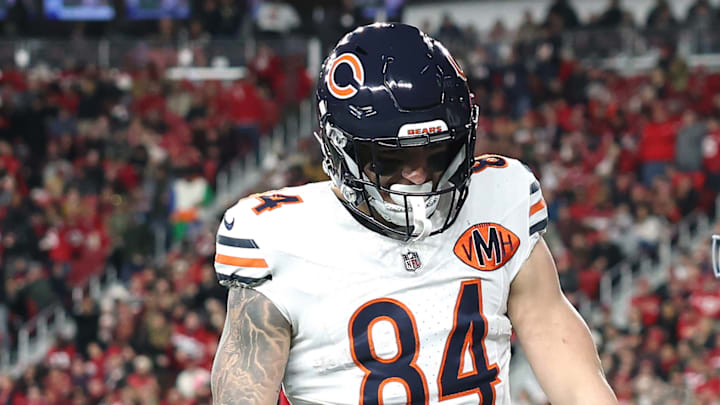
The Chicago Bears (11-5) came up just short against the San Francisco 49ers (12-4) in a Sunday night shootout for the ages, ultimately dropping a 42-38 game on the road to the NFC's potential one seed.
In a game that nearly saw touchdowns on the first and final plays from scrimmage, the Bears proved that, despite the loss, they can hang with the best teams in the NFL, giving fans a lot to look forward to with the start of the playoffs just two weeks away.
The Bears have already clinched a home playoff game and will be playing next week to see if they end up with the NFC's two or three seed, but it is still worth looking at what happened in Week 17, both good and bad, that led to their four-point primetime loss. To see exactly how it all unfolded, look no further than these four stats:
300
Both the Bears and 49ers were led on offense by productive quarterback play from Caleb Williams and Brock Purdy, who both finished with over 300 passing yards on Sunday night.
The game was the eighth time this season that two quarterbacks each accumulated that total in the same game, and just the fifth such game that did not go to overtime. Williams' 330-yard passing total was, in the end, slightly more than Purdy's 303-yard total, but the 49ers' quarterback's five total touchdowns -- three through the air and two on the ground -- outdid Williams' two scores, which both came on passes of 35 yards or more.
Both quarterbacks showcased their abilities in and out of structure, and both commanded offenses that seemed to have all the answers with Ben Johnson and Kyle Shanahan calling the shots. The relation between Williams, a former first overall draft pick, and Purdy, a former Mr. Irrelevant selection, was noted several times leading up to and during the game. While both players made head-turning plays seem routine, the latter passer ultimately got the last laugh.
82%
Of Williams' aforementioned 330 passing yards, a sizable 82% of that production came from rookie pass-catchers, a group that the offense leaned heavily on in Week 17.
Two of the Bears' top picks from last spring, Colston Loveland and Luther Burden III, saw the majority of the action. The tight end accumulated 94 yards and a score on six catches, and was only outdone by the emerging receiver, who compiled 138 yards and a touchdown on eight catches. Undrafted free agent Jahdae Walker finished as the Bears' third most productive receiver with 30 yards on two receptions, and Kyle Monangai tacked on nine yards on three receptions.
In a game where the Bears seemed more eager than ever to air the ball out, Williams leaned heavily on his rookie targets, which was not particularly surprising considering Rome Odunze's continued absence and the affect of a team-wide illness that hit both DJ Moore and Olamide Zaccheus (the latter missed the game while the former played, finishing with one catch for seven yards). While the game didn't go the Bears' way, the loss showcased the big-play ability this offense will have as long as the young nucleus of Williams, Burden, and Loveland stays together under Johnson.
5.9
While the Bears had a tough time against Purdy and the 49ers' passing attack, the defense also struggled to stop the run, allowing 5.9 yards per attempt.
Christian McCaffrey, who finished with 140 rushing yards and a touchdown on 23 carries, remains one of the league's best rushers, especially with Kyle Juszczyk leading the way, but with both Trent Williams and George Kittle missing most of, if not all, the game, the Bears' rushing defense let the team down in a big way.
Week 17 was just the latest poor effort against the run. This year, the Bears have allowed 135 rush yards per game, the fifth-worst mark in the league. On the road, the defense is good for another 10 or so yards per game, and over their last three total outings, that number has shot up to 147 yards per game. While their performance in San Francisco heavily weighs that total, the Bears' recent defensive play, especially against the run, is worrisome and should be a key focus moving into the postseason.
100%
It is no secret that the Bears had few answers for San Francisco's offense, which scored a touchdown on 100% of its red-zone possessions.
Just a week ago, this same Bears' defense was lauded for holding Green Bay to zero red-zone touchdowns on five attempts, but the 49ers found much greater success on their five attempts inside the 20-yard line. The defense has seemingly adopted a "bend, don't break" philosophy in recent weeks, which can work well with defensive backs skilled in zone coverage. Still, they shattered on Sunday night and ultimately were unable to help their offense by keeping San Fran to field-goal attempts.
Read more: Ben Johnson's 6-word answer is exactly what Bears fans wanted to hear for Week 18
Granted, it is hard to envision the Bears' defense playing much worse going forward (in the red zone or anywhere else on the field), but with the obvious talent the defense does possess, it is still worrying that the group was non-competitive in key situations. The defense should get some credit for playing better in the fourth quarter, forcing a punt to help the Bears take their first lead at 7-0, but the defense has to be better at limiting points, especially after allowing long drives down the field.
 Add us as a preferred source on Google