

The Chicago Bears' offense could not have asked for a better start to the 2026 season.
In Week 1, Ben Johnson's offense exploded for 59 points against the Panthers. Johnson leaned on an effective rushing attack, while Caleb Williams and others produced explosive plays and efficiency that Bears fans have dreamed of for decades.
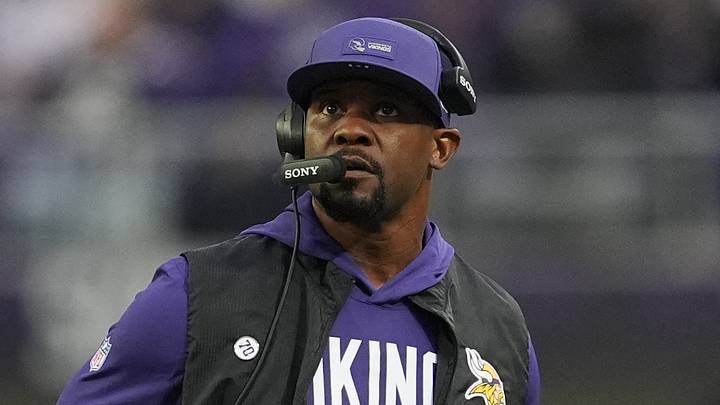
However, if there's one thing to remember heading into Week 2, it's that the Minnesota Vikings' defense will likely look very different from what the team faced in Week 1. The difference in defensive philosophy could make their Week 2 matchup a completely different challenge for Williams, Johnson, and the Bears' offense.
Bears need to be ready for Vikings' defense in Week 2
Against the Chicago Bears in Week 1, Carolina blitzed on about 31% of its defensive plays, allowing Chicago to operate without a relentless barrage of extra rushers.
Minnesota opened its season against the Green Bay Packers with one of the most aggressive defensive game plans you'll see in the NFL. Brian Flores' Vikings blitzed Jordan Love on approximately 78% of his dropbacks. Overall, the Vikings' blitz rate was closer to 82%.
This isn't just a small difference in defensive strategy. It is a completely different set of problems for the offense to solve. Instead of letting Williams routinely identify the coverage and work through his progressions, Flores will likely bring pressure from virtually anywhere on the field.
Now, this doesn't mean Flores will bring the heat on every down. He likes to disguise things, too. This means Williams and the offense will need to account for linebackers attacking the A-gaps, defensive ends coming from the outside, and even defensive backs blitzing at times, while also understanding that pressure may not come at all. That uncertainty is what makes Flores so difficult to prepare for.
You can tell Johnson has a great deal of respect for Flores. Speaking about the matchup this week, Johnson described the challenge:
"Oh, yeah, it comes from all over the place. He'll hit you in the A-gap. He'll hit you from outside the tackles. He likes to bring zero more than any other coordinator in this league."
Johnson added that Flores will bring pressure in virtually every situation, including normal downs, second-and-long, third downs, and the red zone.
"He keeps you on your toes," Johnson said about Flores. "You take a lot of pride in giving the quarterback and the offensive players answers and solutions to whatever problems could unveil themselves on gameday."
I am sure that preparation is going to be tested immediately.
How has Ben Johnson done vs Brian Flores in previous matchups?
The good news is that Ben Johnson has a long history with Brian Flores, dating back to his time as the Lions' offensive coordinator. That familiarity should help the Bears be prepared. In fact, Johnson is 5-1 vs. Flores during his time with the Lions and Bears, but 1-1 going back to last season as the Bears' head coach.
Last year, the Vikings took an extremely aggressive approach in the game they won. In that game, Flores called blitzes on more than 60% of their defensive snaps. In the Bears' loss, Minnesota only blitzed a little more than 30% of its defensive snaps.
The takeaway isn't simply that the Bears win when Flores blitzes more or lose when he blitzes less. Football is far too complicated for that. Instead, the two games illustrate something important about Flores' defense. He can change his approach from one matchup to the next.
You cannot simply study what Minnesota did in the past and assume that's the game plan you'll see this time around. Flores has shown a willingness to alter his pressure packages, coverage structures, and personnel usage based on the opponent and the circumstances. The 2026 Bears are not the Packers. That's an important distinction — especially along the offensive line.
Instead, Ben Johnson and the offense must prepare by accounting for a wide range of possibilities.
The Chicago Bears will face more challenges than just the blitz
Minnesota's defensive challenge may be more than simply preparing for Brian Flores' blitz packages. According to Warren Sharp, Caleb Williams has been significantly more effective against Flores' defense when operating under center.
Since 2025, Williams has posted a +0.28 EPA per dropback, a 74% completion rate and a 63% success rate on under-center passes against flores. From the shotgun, those numbers drop to a -0.01 EPA per dropback, 50% completion rate, and a 44% success rate.
That aligns with a broader trend in Flores' defense. Since the start of 2025, Minnesota has ranked first in EPA per pass and success rate allowed against shotgun passes on early downs. Against under-center passes, the Vikings have ranked 17th and 21st in those respective categories.
The takeaway? The Bears may want to lean more into under-center formations and remain willing to throw on early downs. Sharp's data suggests that's where the Bears can potentially find an advantage against a defense that thrives on making life difficult from the shotgun.
With Williams' ability to create plays outside the offense's structure, Johnson will have to find the right balance, keeping his quarterback comfortable while exploiting Minnesota's tendencies.
Williams will need to demonstrate more than just his ability to make big plays. He'll need to show that he can recognize pressure and coverage indicators pre-snap, make quick, accurate decisions when the pocket is compressed, avoid unnecessary sacks, and trust his protection.
This is what makes this matchup so fascinating. The Panthers game showed us what the Bears' offense can do when everything. The Vikings game will show us how that offense responds when an opposing coordinator refuses to let it operate comfortably.
Read more: 7 Bears who must raise their game against the Vikings in Week 2
If Chicago wants to prove its offensive explosion wasn't a fluke, navigating Brian Flores' defense will be a very important first step.
 Add us as a preferred source on Google