

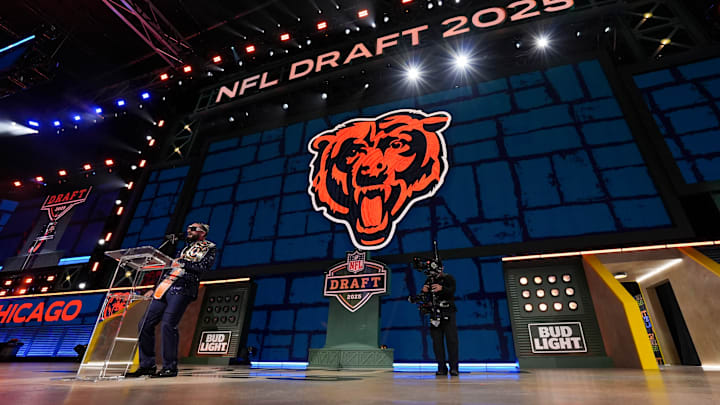
With postseason football on the horizon and a roster that has taken tangible shape over the last two offseasons, Chicago now turns an eye toward the next phase of roster construction.
The objective is no longer foundational rebuilding, but reinforcement. As the Bears look ahead to 2026, the focus shifts to strengthening premium positions, adding depth with purpose, and continuing to insulate the roster against regression or injury.
While much will change before we get to April, with scheme fit, personal evaluation, and conversations with scouts across football in mind, here is an early look at where the Bears could go come April.
Round 1 (No. 25 overall): OL Caleb Lomu, Utah
Lomu may not qualify as a flashy addition, but he represents precisely the type of investment that keeps a roster competitive over multiple seasons.
While Chicago has elite pieces in place along the offensive line, left tackle remains an area where stability has been elusive. Theo Benedet’s struggles and the developmental nature of 2025 Day 2 pick Ozzy Trapilo make this a position worth revisiting early.
Lomu is one of the premier tackle prospects in the class, bringing size, athleticism, and a physical demeanor that fits what the Bears have been building up front, and with established veterans like Joe Thuney, Drew Dalman, and Jonah Jackson inside, plus Darnell Wright entrenched at right tackle, adding Lomu at left tackle could elevate this unit into one of the best offensive lines in football.
Round 2 (No. 57 overall): EDGE Akheem Mesidor, Miami
Mesidor has spent much of the fall playing in the shadow of teammate Reuben Bain, but his own production and tape warrant attention. A big, long, powerful edge rusher who has consistently held his own in the ACC, for Chicago, he adds another body to a pass-rush rotation that benefits from waves of pressure rather than relying on a single dominant presence.
Round 3 (No. 89 overall): CB Keionte Scott, Miami
Scott is one of the more intriguing risers in this class, a defender who finds the football and makes his presence felt regardless of alignment. Chicago has previously dipped into the Miami pipeline with Tyrique Stevenson, and Scott brings a similarly versatile profile.
His projection may not be tied to a single role -- nickel, perimeter corner, or even a safety-like defender in sub-packages -- but his instincts and playmaking ability are undeniable.
Round 4 (No. 131 overall): DL David Oke, Arkansas
A big man in the middle, Oke fills a clear functional need for Chicago’s defense. An actual run-stuffing interior presence, Oke brings size, strength, and anchor ability to the middle of the defensive line.
In a division built around physical football, adding beef on the interior is a necessity, not a luxury. Oke may never be a high-sack producer, but his ability to occupy space, eat double teams, and keep linebackers clean would add immediate value to the Bears’ early-down defensive packages.
Round 5 (No. 164 overall): SAF Bishop Fitzgerald, USC
Fitzgerald, a riser in the class, has experience playing both high and low, shows range on the back end, and brings value on special teams. For Chicago, Fitzgerald profiles as a developmental safety who can contribute immediately in sub-packages and kicking units while pushing for a larger role over time. Given his playmaking traits, there is a real chance he does not last into the middle of Day 3, making this a strong value selection in this exercise.
Round 6 (No. 203 overall): EDGE Patrick Payton, LSU
Payton is a classic traits-based gamble late in the draft. A former Florida State transfer, Payton looks the part at 6-foot-6 over 240 pounds, with length and athletic tools that are difficult to teach. However, consistency and refinement never fully materialized at the collegiate level, but the upside remains intriguing.
In Chicago, Payton would enter a developmental environment where he could be molded into a situational pass rusher. If the light clicks, he has the physical profile to become a valuable rotational piece.
Round 7 (No. 248 overall): LB Eric Gentry, USC
Gentry is one of the most physically unique linebackers to enter the draft in recent memory.
Read more: DJ Moore better be ready for monster game after latest on Bears' Luther Burden
At 6-foot-6, yes, 6-foot-6, he brings rare length to the second level, evoking comparisons to Charles Snowden when he came out of Virginia years ago. Gentry’s size would allow him to function as a hybrid defender, capable of impacting passing lanes, matching up with tight ends, and adding a different dimension to the Bears’ linebacker group.
 Add us as a preferred source on Google