

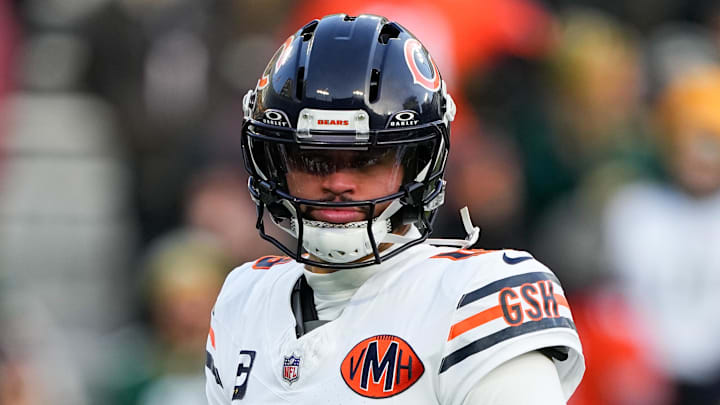
The Chicago Bears (9-4) were on the wrong end of a 28-21 Week 14 divisional contest against the Green Bay Packers (9-3-1), but there is still reason to be optimistic going forward.
Granted, with the loss, the Bears relinquished their hold on the first seed in both the NFC North and the conference. Nonetheless, the Bears were just a few plays away from pulling off the upset win, but to see precisely how it all unfolded at Lambeau Field, look no further than the following three key stats:
76
It was a slow start for the Bears in Week 14, especially on offense, where they accumulated just 76 total yards through the first half.
Most offensive stats from the first 30 minutes were pretty ugly: the Bears punted on four of their five first half possessions, they averaged just 2.6 yards per play, Caleb Williams was six of 14 with 32 yards, and they had two drives in which they went backwards.
The offense struggled to re-establish their identity on the ground that they seemed to find the week prior, and as the game rolled on, the unit was significantly more comfortable and confident. Still, the simple truth from Sunday is that if the Bears could have gotten rolling on offense earlier, it may have gone a different way.
Even though the game was, at times, a hard-to-beat defensive contest, the Bears will find it hard to beat anyone, let alone a formidable divisional opponent on the road, if the offense doesn't get going until after halftime.
3
The Bears did find their rhythm coming out of the break, highlighted by three consecutive second half scoring possessions to get back in the game.
For as bad as the first half was, the Bears' offense was a problem for Green Bay in the second half: Williams was 13 of 21 for 156 yards and two touchdowns, they averaged over 4.6 yards per carry on the ground, and they converted seven of nine on third downs.
Williams had a few spectacular moments, consistently evading pressure to hit players downfield for big plays, such as his one-yard touchdown pass to Olamide Zaccheus, which pulled his team within three points after the disastrous first half. Outside of his underthrown interception on the offense's final snap, Williams continues to play his best football when his best football is needed. If the Bears can continue to marry the dynamic passing attack with a healthy dose of a real downhill run game, Chicago remains one of the toughest offenses to stifle for 60 minutes.
The Bears need to beat the Packers when they come to Chicago in two weeks, but despite the loss, the offense never gave up and put up a strong performance against one of the league's better defenses on the road.
20+
Perhaps the biggest problem on Sunday was the Bears' defense, especially when it came to preventing the big play, evidenced by their allowance of three separate 20+ yard passing touchdowns.
Outside of an interception to C.J. Gardner-Johnson to start the game, quarterback Jordan Love was nearly unstoppable, tossing two long touchdowns to Christian Watson and a third to Bo Melton. Some of these were great throws downfield, and some were more the product of bad defensive game plans.
Watson's second score of the game, for example, was probably more of the latter as the speedy receiver faced a one-on-one matchup against Gardner-Johnson in the slot. The defender stood little chance, allowing Watson to cross face on a slant route, which he took to the house.
Dennis Allen deserves a lot of credit for turning the Bears into the league's best defense at taking the ball away, but that score also showed this defense can be a little too aggressive at times, and Love and company were able to use that against them.
Read more: Bears fans feel conflicted after Ben Johnson's response to end of Packers loss
The Packers were always going to be a tough matchup for this defense, especially after losing Kyler Gordon in pregame warm-ups, but it was ultimately the big plays that did them in. Looking forward, the secondary has to do a better job of keeping receivers in front of them while contesting the deep ball more effectively.
 Add us as a preferred source on Google