

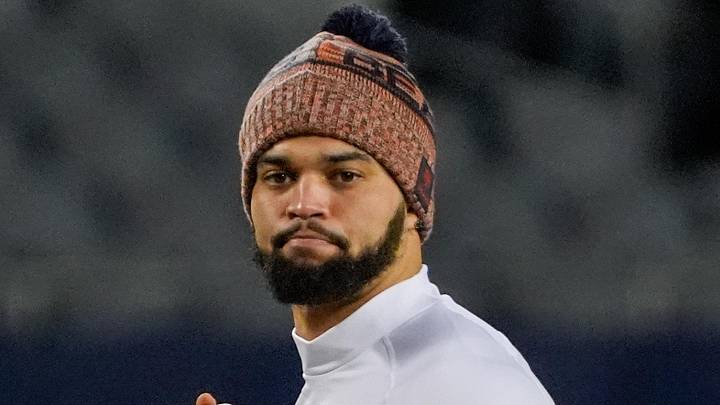
After he led seven fourth quarter comebacks last season, Chicago Bears quarterback Caleb Williams applied to trademark his "Iceman" nickname. Anyone in his position would effort to capitalize on the nickname.
There were potential issues from the start, primarily rooted in the well-known nickname of Pro Basketball Hall of Famer George Gervin. Gervin, apparently (and finally) spurred to action by Williams, applied to trademark the "Iceman" nickname four days after the Bears' signal caller did.
UFC Hall of Famer Chuck Liddell's nickname was "The Iceman", and Val Kimer's iconic character from the original Top Gun movie also has the "Iceman" nickname. So getting the trademark of the nickname was always going to be difficult for Williams, since it's simply not unique or original.
Caleb Williams' attempt to trademark "Iceman" nickname has been denied (for now)
According to ESPN's Michael Rothstein, as of Wednesday, June 24 the United States Patent and Trademark Office has refused Williams' initial trademark application.
In addition to clothing, Williams applied for trademarks related to athletic bags, digital trading cards, water bottles, sporting goods (footballs, etc.), a website and entertainment services. His trademark application for an Iceman logo, separate from the word, remains under initial review by the USPTO.
The refusal by the USPTO is not due to any conflict related to Gervin's application or Liddell's trademark of his nickname. Instead, too much similarity and a "likelihood of confusion" with a trademark filed in 1988 by LaCrosse Footwear for insulated boots has been cited as the reason.
Per Rothstein:
"LaCrosse, an Oregon-based footwear company, owns the trademark "Iceman" for one of its boots and boot liners. Williams had applied for trademarks in multiple categories, including clothing, and that allowed the USPTO to offer the broad refusal of his application."
"These marks are identical in appearance, sound and meaning," the USPTO wrote in its refusal letter. "... Additionally, because they are identical, these marks are likely to engender the same connotation and overall commercial impression when considered in connection with applicant's and registrant's respective goods and/or services."
According to Josh Gerben, a patent attorney with Gerben IP, an initial refusal of a trademark applicatiion is pretty common. So far in 2026, roughly 65 percent of new trademark applications reviewed by the USPTO have been refused. Rothstein cited USPTO data to put that percentage at precisely 63.5 percent.
So two out of every three initial trademark applications, give or take, have been rejected this year as we near half of 2026 being in the books.
Gerben, in comments shared by Rothstein, seems to think Williams, if he chooses to do so, has a solid case to win an appeal of the rejection.
"The registration that they're citing here is for obviously a very limited product line. Literally insulated boots," Gerben said. "Look, it might be harder for him to get Iceman registered for a brand of clothing items because of that, but there's other things in his application that he could possibly still wind up with a registration here."
Gerben also questioned, due to the range of Williams' trademark application, the connection to LaCrosse's existing trademark, which is solely focused on one of their lines of boots. A "likelihood of confusion" is absolutely a stretch.
"They make the connection between the other goods in Caleb's application, saying that even though these are just insulated boots and Caleb is claiming shirts and hats and pants and all these other things, that those are related goods."
Read more: Bears analyst highlights easily overlooked aspect of Ryan Poles' work
Williams will surely exercise his right to appeal the initial refusal of his trademark application. The timeline for that to happen, and for any change that would allow him to use the word as he sees fit, is to be determined.
 Add us as a preferred source on Google