

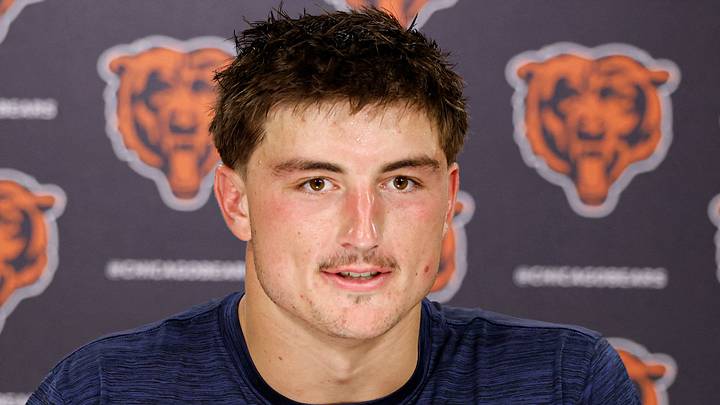
It took a little time, around an injury recovery that limited him during training camp, but Chicago Bears tight end Colston Loveland hit his stride over the course of his rookie season. Looking toward this season, even head coach Ben Johnson can't hide his optimism.
“He’s one of the most consistent players I’ve ever been around, and that’s saying a lot,"Johnson said in June. "I'm really happy with where he is at right now. We are able to take the route tree to the next level."
The full-season pace Loveland set over the final four games of his rookie season (including the two playoff games) is not sustainable, for any number of reasons. It also doesn't have to be fully sustainable in order for him to have a full-on breakout in Year 2, and pay off a rise in his fantasy stock as 2026 draft season begins to hit full-tilt.
Under the premise of "who is the real sophomore TE1?" in fantasy for 2026, Scott Barrett of Fantasy Points tried to discount what Loveland did in his final four games last season (presumably the aforementioned excellent stretch) compared to what Cleveland Browns tight end Harold Fannin did over his last four games in 2025.
Lame Colston Loveland take was not necessary to prop another Year 2 TE up
A lot has been made about Colston Loveland's final 4 games of the 2025 season (the only games all year he was any good)
— Scott Barrett (@ScottBarrettDFB) July 2, 2026
Here's how his final 4 games stack up against the final 4 games* of Harold Fannin Jr. (who is 5 rounds cheaper)
*technically 16 full quarters vs. 16 full… pic.twitter.com/oZsybk2LRy
Most of the reactions to Barrett in the comments of that tweet are as expected.
From Week 9-Week 18 last year Loveland was the TE2 in fantasy regardless of scoring format. If you narrow to Week 17, the end point in the majority of leagues, he was still a top-5 tight end across the board.
Someone who makes their hay as a fantasy analyst would presumably know those things. Or at least know Loveland's final four games last season were hardly the "only games all year he was any good."
Barrett pretty clearly cherry-picked stat areas where Fannin excelled, and Loveland was not as good in comparison over their respective final four games/16 full healthy quarters.
The multi-round gap in Average Draft Position between Loveland and Fannin is absolutely a conversation that can be had, and Loveland's lofty ADP adds an unappealing layer of risk for some fantasy managers. Especially those who Barrett admitted he is among in the comments of his tweet, who like to wait to draft a tight end.
Read more: Key to improvement for Bears' defense in 2026 has been shown by one data split
If Loveland is to be discounted in a comparison to Fannin in an effort to prop Fannin up, which he absolutely can be based on the numbers Barrett used, adding a provably untrue layer about only having four good games last season was not necessary to do it.
 Add us as a preferred source on Google