

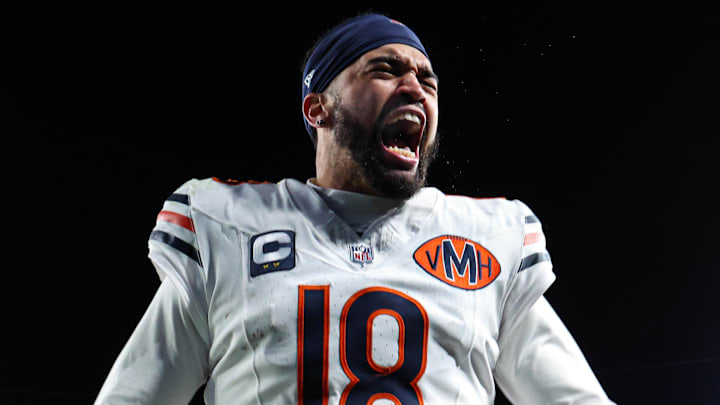
The Chicago Bears arrive at the postseason at a moment that feels both overdue and perfectly timed.
Make no mistake about it, this isn't a roster stumbling into January. It's a roster arriving with intention, structure, and clarity, led by the exact player they envisioned when they turned in the card for Caleb Williams at No. 1 overall in 2024.
Wild Card Weekend is his first taste of playoff football, and that matters. It matters for Williams, for head coach Ben Johnson, and for an organization that has spent years trying to align quarterback, coaching, and roster construction on the same timeline.
Williams is the axis point of everything that comes next. Chicago drafted him not simply to stabilize the position, but to elevate the franchise. Through 2025, he has validated that vision. His command inside the pocket, creativity outside of structure, and ability to survive chaos without abandoning discipline have already placed him among the more fundamentally talented quarterbacks in football, with his ability to change a game.
However, this playoff run is not about proving he belongs. That part is done. It is about answering the harder question: can his game scale when margins tighten, when defenses are disciplined, and when the season can end in one night?
The Bears believe it can, and the infrastructure around him supports that belief.
Examining Bears' roster around Caleb Williams
On the perimeter, Rome Odunze is exactly what they hoped he would be. A first-round pick in 2024, Odunze is already a core piece and a matchup problem who wins with size and outstanding route-running for a player with his mass.
DJ Moore also remains one of the more complete receivers in football and, despite his tenure, still fits the long-term vision. His versatility allows Chicago to stress defenses at all three levels while keeping Williams protected with defined reads.
Then there's Luther Burden III, a second-rounder in 2025 out of Missouri, who adds another layer. His ability to align inside or outside, combined with flashes of dynamic playmaking as a rookie (check out the San Francisco and Dallas tape), gives Ben Johnson a movable chess piece. Behind that trio, the depth becomes more transient. Devin Duvernay, Olamide Zaccheaus, and Jahdae Walker have contributed in spots, but none project as pillars.
At tight end, the Bears are quietly built for multiplicity. Colston Loveland, a first-round pick out of Michigan, is the future at the position. His presence alongside Cole Kmet allows Chicago to live in 12 personnel without sacrificing explosiveness or disguise. Kmet, a second-round pick in 2020, remains a core piece who understands leverage, blocking responsibilities, and spacing in the middle of the field, and together with Loveland, they give Johnson the freedom to dictate matchups rather than react to them.
Up front, the offensive line tells a story of staggered timelines. The interior leans veteran with Joe Thuney, Drew Dalman, and Jonah Jackson providing stability and flat-out dominant play at times this fall, specifically for Thuney (zero sacks allowed in 642 pass pro snaps). On the edges, though, the youth movement is evident.
Ozzy Trapilo projects as the long-term answer at left tackle. On the right side, Darnell Wright continues to look like one of the better tackles in football. Protecting the arm side of Caleb Williams is not optional, and Wright has become a foundational piece since arriving as a first-round pick in 2023.
The backfield is more fluid. D’Andre Swift isn't a part of the long-term plan, but Kyle Monangai is, and he's remained one of the best stories of the season. A seventh-round pick out of Rutgers, Monangai runs with vision and outstanding contact balance, earning a role alongside Williams for the next few seasons even if Chicago ultimately looks to add more top-end talent at the position.
Defensively, the Bears are built around veterans, but the core is younger than it appears. Montez Sweat, Grady Jarrett, T.J. Edwards, Tremaine Edmunds, Kevin Byard, and C.J. Gardner-Johnson provide experience and physicality, but they also allow the younger pieces to develop without overexposure.
Austin Booker has quietly become one of the more encouraging young pieces up front.
Austin Booker has quietly become a week to week force off the edge for Chicago.
— Ryan Fowler (@_RyanFowler_) December 21, 2025
16 total pressures over the last month including 3.5 sacks the last two weeks combined. Another four pressures tonight.
A day three pick out of Kansas in 2024, Booker has shown growth as a rotational pass rusher and looks like someone who can be part of the solution moving forward.
The back end is where Chicago’s long-term defensive identity truly lives, where DBs coach Al Harris’ influence is evident. Nahshon Wright, once an afterthought in Dallas, has become one of the more ball-productive corners in football under his guidance, totaling five interceptions and six pass breakups in the regular season. Jaylon Johnson, when healthy, remains one of the better corners in football.
When healthy, Kyler Gordon’s versatility gives the Bears flexibility across matchups. Tyrique Stevenson has had his flashes despite the major roller coaster ride that his career has been on for the past three seasons. And Jaquan Brisker, when available, is a tone-setting presence who can play at multiple levels of the defense and still fits the long-term vision despite entering year five in 2026.
Overall, this Bears roster is not built on hope -- it's built on alignment. Caleb Williams, Ben Johnson, and a supporting cast that blends youth with experience give Chicago something it's rarely had: continuity with upside.
Read more: Ben Johnson opens up about meaning behind Bears playing in postseason
The playoffs are the next step, not the finish line. What matters now is that the Bears finally look like a team whose best football is still ahead of them.
 Add us as a preferred source on Google