

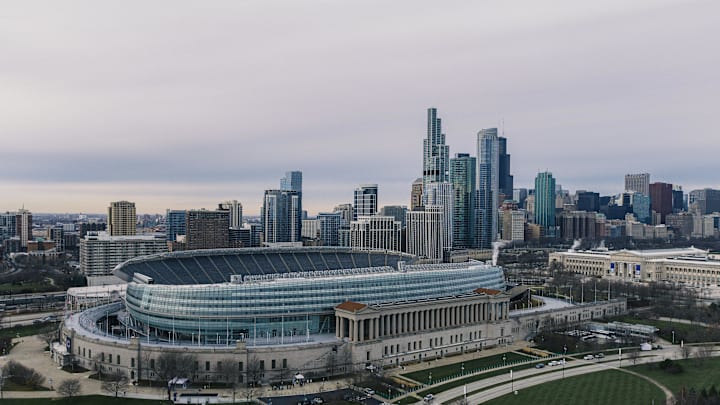
We are in the final month of negotiations on the Megaproject Bill, HB0910 involving the Chicago Bears.
This is the legislation Illinois is working on to keep the Bears in the state. A framework was established earlier this year, and the third amendment was finally passed by the Illinois House in April. The bill now sits with the Senate, and it doesn't sound like they plan to pass it as-is.
The Chicago Bears met with the NFL's Stadium Committee shortly after the conclusion of the 2026 NFL Draft. During that meeting, the city of Chicago was officially eliminated, leaving only Arlington Heights and Hammond as the two remaining sites under consideration.
There has been speculation that the Bears will need to decide on a location for their new stadium before attending the NFL's quarterly meetings on May 19 and 20, but that's not what I am hearing. It seems more likely that a decision will come immediately after Illinois lawmakers adjourn at the end of May.
After the House voted to pass the Megaprojects Bill, the Chicago Bears released an official statement—and it did not exactly inspire confidence.
JUST IN: Bears react to House passage of Megaprojects Bill: "We welcome the progress made on the House’s version of the mega project bill; however, additional amendments are necessary to make the Arlington Heights site feasible for our stadium project. We support Illinois…
— Paris Schutz (@paschutz) April 23, 2026
What Bears fans should know about the bill to keep the team in Illinois
According to a recent report from Crain's Chicago Business, the property tax relief mechanism in the bill is becoming a major point of contention. The Senate reportedly wants to keep the provision in place, while the Bears oppose it.
I have been very supportive of the Bears throughout this stadium process. The state hasn't prioritized the stadium project, which has opened the door for Indiana to emerge as a legitimate contender. Illinois lawmakers have played games and would shoulder most of the blame if the Bears ultimately leave. That said, the Bears' latest complaints about this bill are starting to feel a bit unreasonable.
The property tax mechanism the Bears are reportedly pushing back on includes a provision that dedicates 50% of their annual payments in lieu of taxes (PILOT) toward property tax relief for residents. Of that portion, 60% would go toward rebates for residents within the taxing district, while the remaining 40% would go into a statewide relief fund.
One might wonder why the Bears would be upset with this proposal. Some believe the provision could complicate PILOT negotiations, while others argue it could push taxing districts to demand twice as much as they otherwise would. That's a stretch.
Even without a hard cap written into the bill, this isn't just a Bears-specific piece of legislation. Developers always have the option to walk away if they can't reach a reasonable PILOT agreement.
A look at why the Chicago Bears don't like the current Megaprojects Bill
The idea of "wanting double" does not hold up under scrutiny. Let's use the Chicago Bears stadium situation as an example:
The current tax payment on the Arlington Heights site is roughtly $3.9 million, all of which goes to local taxing authorities.
If no PILOT legislation is passed and the Bears were to build in Arlington Heights, their annual property tax bill could easily exceed $100 million—and potentially climb north of $200 million per year. Again, all of that would go to local taxing authorities. There's no realistic scenario in which the Bears would agree to that, and frankly, they shouldn't. Especially, when the highest known stadium property payment (SoFi Stadium) is under $9 million annually.
If the Megaprojects Bill passes, a negotiated PILOT would likely land in the $10-$12 million per year range. Even with the 50% property tax relief provision in place, Arlington Heights shouldn’t need or expect more. A stadium development isn't going to drive significant new demand for school funding, which typically accounts for 60% or more of property tax allocations. At that level, a single PILOT payment would represent roughly 25% of the village's 2025 property tax revenue.
As currently proposed, the structure would look something like this:
Roughly $5-$6 million would go directly to the Arlington Heights region. That alone is already $1-$2 million more per year than the site currently generates as vacant land—and that's only half of the total PILOT.
Of the remaining 50%, 60% would remain within the Arlington Heights area but would be earmarked specifically for taxpayer relief. That translates to roughly $3-$3.5 millionin reduced property tax burden for residents, covered by the Bears' PILOT. Even then, the region still nets $1-$2 million more annually than it does today, while residents get a modest tax break.
The remaining 40% would go into a statewide property tax relief fund. In practical terms, that's roughly $2-$2.5 million from the Bears' PILOT being redistributed through the state, with residents receiving equivalent tax, 40% will be applied to a statewide property tax relief fund.
However, the Chicago Bears appear to want that $5-$6 million (the intial 50%) to remain entirely within the Arlington Heights region—but not for taxpayer relief. Instead, it would likely be used to offset debt and development-related costs tied directly to the project.
Read more: New 2027 mock draft suggests Bears might have to consider life without All-Pro
That's where this starts to feel off. Developers shouldn't have that level of control in these negotiations. Howeowners certainly don't. If everyday taxpayers can't redirect their own property tax savings for personal benefit, it's fair to ask why a billion-dollar franchise should be able to do so.
 Add us as a preferred source on Google